
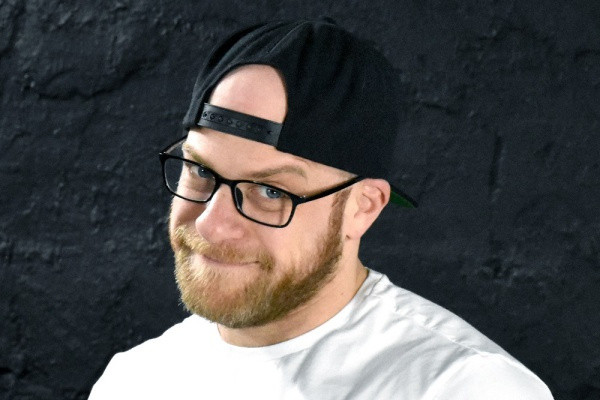
Comedian and writer Jeremy Dobski loves to make people laugh. He has brought his well-crafted jokes and kinetic delivery to stages across Canada and the US, spreading the joy of human connection with him everywhere he goes. That joy of connection is also captured in his 2024 special Love Language. Jeremy will be playing his last shows of the year across Ontario and Michigan starting later this month.
Last month, Jeremy joined forces once again with longtime friend and collaborator comedian (and founder of Punx Can't Laugh) Gabe Koury to co-produce the second Punx Can’t Laugh Fest in Toronto. This year’s festival saw them expand to four days, which featured five shows jam-packed with hilarious comedians and rocking punk bands. Punknews editor Em Moore caught up with Jeremy to talk about this year’s Punx Can’t Laugh Fest, throwing shows on a pirate ship, incorporating storytelling into stand-up thanks to his animated show Para-Legal, and so much more. Read the interview below!
This interview between Em Moore and Jeremy Dobski took place over Zoom on November 5, 2025. What follows is a transcription of their conversation that has been lightly edited for length and clarity.
This is your 2nd year co-producing Punx Can’t Laugh Fest with Gabe Koury, who’s your longtime friend and collaborator. How did you get involved in Punx Can’t Laugh Fest?
I’ve known Gabe for almost 15 years now. We met in Montreal years ago. I had just started doing stand-up and he hadn’t started doing stand-up yet, but we were both involved in the music scene. I was actually more involved in the hip-hop scene in Montreal. I was in a hip-hop group called Defective Collective and we were around for a while. Gabe and I had a lot of mutual friends. Then he was around doing comedy and we both moved to Toronto around the same time. In that time, Gabe started doing Punx Can’t Laugh, as I’m sure he detailed in his interview. It started out as an open mic, then it became a show, and it wasn’t until years later that I really got involved.
Gabe would invite me out to do Pouzza and I would do the comedy show there. A lot of acts would go and do the show and then they’d go back to Toronto or they’d go to another thing in Montreal. I was actually excited to witness and be part of the whole festival and listen to the music, go see this band and that band. My first year of the festival was Cancer Bats, so I was stoked on it. I think as a result of all of that Gabe saw that he should have me back, so I started going back to Pouzza almost yearly. Then he would invite me to a lot of Punx Can’t Laugh shows because he knew I was excited about it, that I would get involved, that I would appreciate the music, and that I wouldn’t just leave.
Then maybe 2 years ago, before we started doing the actual festival, I was auditioning for this festival and really unfortunately, the message I got after the fact was, “Hey, you did such a great job last night! We’re so excited that you participated, but now we just wanna see that you can bring us an audience from your online presence.” Which defeats the original purpose of doing these festivals, usually it’s to showcase talent so that the talent can have an avenue that they didn’t have before or it’s a way to build an audience as a result of having more visibility. I was kinda upset about this. There were a few instances of, “If you can bring us an audience, that would be really great!” It’s like, “Yeah, if you have a lawn that you’d like mowed, I’m sure you’d like me to do that too.” So instead of getting bitter about it, I reached out to Gabe like, “Look, we already both have our respective audiences. Punx Can’t Laugh has been doing well for years. What if we did a festival?” He loved the idea. We did a couple of pop-ups to test out the newer format of the show for the festival: a couple bands, then the comedy, then another couple bands. We did a really great show at Bar Orwell and that set us in motion.
You said you were mostly involved in the hip-hop scene. What got you into punk music?
I was involved in the hip-hop scene, but I’m just a music guy. I love music. I love obscure music. I love weird music. I like aggressive music. I like funny music. I’ve just always been a music guy and growing up, I was involved in the punk scene. I’m more into hardcore and post-punk than pop-punk or anything like that. Growing up I listened to the classics; I still do. I love me some Misfits, some Ramones, some DK. I was always in the punk scene; I was just a little bit more into hardcore. From a young age, I was just always into anti-establishment type of art, and that brought me to punk music.
There’s such a big connection between punk and comedy.
Yeah, exactly! They’re both rude art forms and I think there’s too much emphasis on everybody being nice - I don’t mean that in a way where you should be a bully or anything like that, I think that in order to make art, you’ve gotta upset some people. People want comedy to be nice and friendly and people want punk music to be clean and friendly and they just aren’t. They’re not supposed to be. We’re supposed to push buttons and ask questions and say the wrong thing and do the wrong thing and see what happens. I think they’re both big “fuck around and find out” genres of art. [laughs]
What went into putting this year’s festival together?
This was the first year that we accepted submissions and we weren’t sure how that was gonna go. It was really interesting because we ended up branching out to other cities and people from different places, as opposed to last year when we kept it fairly local. We like to keep it fairly local anyway, but we wanted to see what would happen if we brought other independent acts in because as much as we want to keep it local and Canadian, we do appreciate the fact that there is so much talent that isn’t being given visibility because it’s not nice and friendly and clean and doesn’t fit into the boxes.
I think that’s a big part of what we were looking for in submissions, like-minded people who would come and enjoy the festival. I think we got that this year, I really do. We made some really wonderful contacts and there were some great acts who showed up. There was one guy in particular who showed up on day one and was there until the last day and participated in everything. That’s what we look for! Gabe and I really connected in that he saw that I really appreciated what he was doing and he appreciated what I was doing and we connected in that way. I think that’s a huge factor in growth in general, creating that value for others and therefore building for yourself. That’s a big part of what we wanted to do and I think there’s a lot of that missing nowadays.
I think the internet has created this religion of Me like, “Look at me! Look at me! Look at me!” But, then, you’re all alone and where are you going? What are we building here? What if we did it together? DIY is all about that and we’re all DIY. I’ve always been that way and Gabe’s always been that way and I think that’s another reason we connected. We were just putting on our own solo events. There was a place called the Death House, which was the one I was most familiar with out of the Fattal Lofts in Montreal. They would do parties there, people would squat in them, and there were event spaces within these living places. They were these old, run-down lofts made of wood, by the train tracks in the middle of St Rémi in Montreal. They were just kinda hidden off to the side, no one would know about them unless you knew about them. I was the first person to bring both comedy and hip-hop music to these random punk squatter venues.
I always had the DIY punk rock mentality, no matter what I was doing, so I brought that there. I think that was another reason we connected, because I was the lunatic who was like, “Let’s do a comedy show in this strange, squatter’s lodge!” I’ve always been a DIY guy. I always like to do stuff that’s strange and obscure. I don’t like to put on events that are like any others, even if that means finding an obscure location to do an event where there’s never been that genre there or whatnot.
Where’s the most obscure place you’ve put on an event?
I’ve done a lot of different events, some that I’ve put on, and some that others have put on. For years I would put on these comedy shows on a pirate ship and that was one of my favourites. It was in the Toronto Harbour and was like a kids’ theatre. We wouldn’t go out onto the water, we would just stand on the boat and people would sit on the dock and we would be doing comedy from this pirate ship. [laughs] Some people would sit on the boat with us because there was seating around us. We did it to raise money for ocean clean-up. It was a really silly, fun time. We had to be a little more cautious in terms of content because it was public and there were kids walking by. It was also really fun to censor ourselves in a way that was still palatable to a comedy audience.
But the Death House might also be one of the number ones. During the pandemic, we did shows in my backyard because we were a house full of comics. We called it Dirt House Comedy because we have the ugly house in the neighbourhood. Those were a lot of fun too.
With self-censorship, did you find it a creative exercise in how you put your set together?
It was really fun because it involved a little bit of improv. I had a joke where I had to say the word “shit” a lot and I replaced it with the word “crap” and people knew I was censoring myself, so it was really funny because it’s such a silly, cartoony word to use. The way I would enunciate was based on the fact that I’d catch myself, so people would see me editing as I went along. I think we all got a kick out of doing that because it’s not easy and when you slip up it’s like, “Oh, we got ya!” It was like a fun challenge. Some comics might get a little butthurt about having to do it, but your audience is your audience and that’s what you get.
It’s that energy exchange.
Totally! You don’t always get to have everything your way and honestly, you shouldn’t. I think a lot of performers forget that the audience is there. It’s not an audience, it’s this audience here, right now, who came to see this exact thing. No matter what you’re doing, where you are, or what the conditions are, they showed up. You need to give them as much as they give you, if not more. You owe them; they paid money, they showed up, and they gave you their time, especially nowadays when everything is expensive, everything is difficult, and everyone is running late in Toronto. I don’t care if it’s two people that’ve shown up or a thousand people who’ve shown up; they deserve to get exactly what they paid for.
It doesn’t matter what the size of the crowd is.
No, and I don’t think we should be so precious. I think we should be more grateful. How fucking lucky are you to be someone who gets to do something that you love, that you enjoy? I need to hear this myself because I beat myself up a lot, but how fucking lucky am I? My grandparents would never have thought that this was even possible for me to be silly for a living or to make music for a living or to get in front of a group of people and have fun with them. How lucky are you and how grateful should you be? You should be super grateful for it; it’s not even a question.
You also performed at Punx Can’t Laugh Fest this year.
I hosted one of the nights and then I was billed to perform on a show but we had a drop out for our headliner, so I ended up headlining. It was a lot of fun. The hosting gig was a blast! It was really fun. I have a lot of experience hosting and I love a rowdy audience so it’s really fun to wrangle - and it is wrangling with punks at 11 o’clock after some bands have played, especially bands as hard as Heart and Lung or Snakes - and rile them up at the same time, but get them ready for other people. It was a good time.
You get into that flow state.
That’s the thing, you actually don’t get to have a flow state with an audience like this. You have to lean into whatever is happening and you have to be as chaotic, if not more chaotic, than they are, especially if they’re standing and they’ve been drinking and a bunch of music has happened. They’re not really sure what to expect from the show and I get to go up there and be like, “Alright, you want chaos? I’ll bring you some chaos!” [laughs] Those guys had music that they planned. I have no idea what the fuck is about to happen. [laughs]
How do you feel this year’s festival went overall?
I’m happy when everyone has had a good time. That’s the purpose. This year I think we had a few more challenges to deal with, which is great because the first year went pretty much perfectly. This year we had more challenges just in terms of production stuff. That’s fine, that’s gonna happen running a festival, with running an event. We got to learn. But if people walk away happy, if people walk away with a unique experience, and if people walk away feeling like they got their money’s worth, then that’s all that really matters. As producers, we have to take risks. It’s always gonna be a risk and we can only hope to grow from here.
Did you have a proudest moment from this year?
For me, as a performer, I would say the hosting gig. It was really fun. That Friday night show was superb, which is a word that I never use, but that’s how I would describe it. It was everything we wanted. The bands were happy, the audience was happy, the comics were happy, and the headliner had a blast. She came in from Detroit to do it and had just gotten out of the car. It’s hard to shake off a four-hour drive and just get on stage and kill it. I’m super proud of how that night went. Everybody was so on point, everybody was so fantastic, and it was beautiful to see.
To shift gears a bit to you, you released your special Love Language in 2024. How did you decide which material to record?
That was actually a really interesting little journey. I originally started writing this thing in 2019-2020 then everything got shut down. I was gonna do a fringe event to test it out and I’m so glad that I didn’t because when I had that hiatus, I was able to go back and look at the material and say, “This isn’t what I want at all.” [laughs] I recorded it in 2023 and it was released in 2024. In 2023, I started writing my animated series, Para-Legal, which is about ghost lawyers, and in that time I learnt a lot about storytelling. When you’re creating something you keep going, “Oh, it’s gonna go like this,” and then it doesn’t; it never does. You end up going, “What if I went this way? What if I go that way? Which way can I go with this?” When I started, I think I was trying to force a little bit too much. I had an idea of what I wanted it to be and the name of the special kept shifting as this was happening. I was like, “I’ll call it this, that would be so clever!” One thing I learned about telling a story - “story” loosely - is that the story dictates itself to you. You don’t get to force the hand, you don’t get to be like, “This is how the story’s going to go. This is such a clever idea, I’m going to hamfist it in here.” It doesn’t work that way; you have to let things unfold themselves.
One decision that I made that I’m grateful for in this special is that I didn’t want the special to be too personal. I think that a lot of comics start off being like, “Here’s how I grew up. Here’s my mom, here’s my dad, this is what my dog looks like. You want to see all the pictures in my wallet?” [laughs] I was like, “I just wanna say silly stuff to the audience. I want to talk about the pandemic so I never have to do that ever again and I have a couple topical things that seem to come back every year,” like forest fires, for example. I was like, “Perfect, let’s throw it in there.” I really just wanted to be silly and to showcase my personality and who I am more than I wanted to get real into the muck of my life. What I ended up learning is that no matter what, I had to tell a story and when you watch Love Language you’ll see that there is an arc and there is a story being told, but it’s more about following me through my brain than it is through the story of my life. Now, my next special is probably going to be a little bit more personal. I have some personal challenges going on in my life that I would like to throw in there and in fact I started writing it and once again, had to go, “No, not it.” I’m starting from scratch all over again.
With Love Language, I picked stuff that I didn’t wanna say anymore and I picked stuff that chose itself. Some of those jokes were written a week before, they just happened to pop in my head and I was like, “This is perfect! It fits right here and it works.” The last joke of the special I wasn’t satisfied with and I think I put the last words down at 2pm the day of the recording. I was so confident like, “There’s no way that this combination of words isn’t going to work,” and that’s the only time I felt that confident about a joke. It doesn’t matter if I’ve been telling it for ten years or not, that was the only time I was like, “This is how the joke is told.” And it works! I had never said those words out loud before I went up on stage.
There is one moment in it where I accidentally did crowd work, but I am that comic who riles up an audience and will end up accidentally getting someone to participate. People were out of their minds during the second show too. There were couples making out here and there and I wasn’t saying anything all that sexy. There were people dropping things and people were shouting. I just rile people up and I guess I make them horny, I don’t know. [laughs]
I watch it now and I’m like, “Man, I’m so much better than this guy,” which is great. [laughs] But I think the one lesson I got from it is you have to kill your darlings in order to grow, so I just had to do it in order to become a better comic. I had to do it in order to learn what it is to create a special because when I started I just had a pile of jokes, there was no narrative. I noticed when I would tell a joke on stage, it would get laughs, but it wasn’t really connecting with people; people weren’t necessarily engaging. There was one joke in particular where I felt that 70-75% of the audience was there for me, but the other 20-15% were like, “What is this?” I realized it was because I wasn’t bridging the gap for them; I was making them do too much mental gymnastics. I say, “You guys might think I’m bald, but I know that my baby hair has fallen out and I’m waiting for my adult hair to grow back in.” Now, most people will go, “Oh, baby teeth!” But some people didn’t, so I had to go, “Remember when your teeth fell out? That was way worse than when my hair fell out!” If you’re going to connect with people, you need to tell them a story.
Do you have a joke that you’ve written that you’re proudest of?
Hmmm, that’s a hard question. My brain is full of too many jokes and I’m proud of a lot of them. There are more jokes I would say that I’m just fed up with. I’m really proud of my closer in Love Language and how I lead the audience there. That’s the one about life insurance and how it follows the joke about “you can’t kill yourself in your 30s because it’s not dramatic anymore.” But I’m not precious about my material. I really love watching it grow. I love letting it go and I like letting it come back. I have some new stuff that I’m really excited by. It also depends on the moment because I get bored of my jokes too. I get bored of saying it and then it comes back and I’m like, “Oh yeah, this one!”
I like taking people to scary places. I think my proudest moments aren’t the jokes, it’s the way that I connect with the audience. Again, it’s connecting with people, it’s bringing value to others, like, “Let’s go to the scary place and at the end, I promise I’ll give you a hug and a kiss on the forehead. We’re gonna be ok.” That’s my favourite thing to do, push people just far enough and be like, “But we’re friends. But I love you. But this is for fun. Remember, we’re having fun.”
One of the things I really like about comedy is that you have the space to do that.
I think there’s a big problem right now where people are just trying to make points and I think it pushes people away. I think if you make a point by accident telling a joke, great. But I think our job is first to tell jokes and be funny and then we can go to making points. I think a big problem is people who do comedy to be adversarial, to hurt people with their words. I don’t think that’s right. I think that making people laugh is a joyful thing. It’s universal truths that we’re supposed to be saying. It’s love.
A big reason why the special is called Love Language is, obviously there’s the joke in the special about my love language, but also telling jokes is how I love. Making people laugh and making people feel good is so important to me. But I also love words and I love language. It’s this place on all of these things. What it really comes down to is that this is the only way that I know how to connect with people on a large scale, otherwise keep me out of the crowd. I’m glad that it seems like comedy is coming back around to audiences just wanting jokes. Just tell your jokes, let’s have a laugh, let’s have a good time. I don’t want anybody leaving upset.
You wanna create that environment and have that shared experience.
Totally! I’ve had people leave upset. Sometimes they’re just upset and whatever, there’s no discussion to be had. One of the greatest moments I’ve ever had was someone was upset with a joke and I asked them what they heard. I didn’t ask them, “What was the joke?” I said, “What did you hear?” They explained to me how they connected with it in a negative way, how they heard something that I didn’t realize was in the joke. So I learned from that to be like, “Ok, I’m not going to throw this joke away because that person was offended. What I’m going to do is I’m going to try to figure out a way to say this thing in a way where that person can join in. Where they can go through that difficult moment and in the end know that I’m going to give them a hug.”
But I’ve also had people get mad about absolutely nothing. I’m very bald, I’m a bald guy. In my special, I pick bald guys out of the audience and whatnot. One night, there were seven bald guys and I was so excited! I was doing crowd work like, “Look at this bald guy!” Then I point out one other bald guy and he flipped out, went “Fuck you, Jeremy,” and threw a chair at me. He was as bald, if not somehow balder, than me and I was like, “At least he remembered my name!” [laughs] It was such a bizarre moment. It doesn’t make any sense that would’ve happened, but sometimes you can’t control what people experience when they experience your art. I suppose that night I riled him up a little bit. I just wanna clarify that I am a full-on bald rights activist. I wasn’t making fun of him for being bald; I was encouraging people to see how beautiful bald men are. But sometimes there are some self-hating balds out there.
Good thing you didn’t get hit by the chair.
Yeah, nobody got hit by the chair. Luckily, it got stuck under a table leg. He went to throw it and it went and then it fell back. It was incredibly strange. It was at the beginning of the show I was hosting, so for the rest of the night there was an energy. [laughs]
You have your last shows of the year coming up. What are you looking forward to about these shows?
I’ve been really lucky to be working with a producer right now who has been booking me on some really solid gigs, full rooms. I’ve been on the road with my friends lately, which is nice because we’re all touring all the time and we’re never really in a place where we’re in the same city at the same time. I’m really looking forward to having some stage time with some close friends. I like traveling, so I have a couple more gigs out in Michigan coming up and that’s gonna be nice. Looking forward to some road time, especially with good people, that’s all I really want: good gigs, good people, good pay, maybe some good food.
The keys to a good life right there.
I just wanna have a good life, man. [laughs]
Is there anything that you can talk about with the animated series going forward?
Everything is in production hell right now. Much like how festivals are asking you about your numbers, production studios are doing the same. It's such a great idea, everyone’s super ecstatic about it. We’re super proud of it. We worked super hard on it. The trailer is out and people should watch it. If you love it, make sure to tell people to watch it. Get it bigger and bigger. The further it is pushed by an audience that wants it, the more likely that it will finally see the light of day.
We have some legends on the show! We have three of the Kids in the Hall and we have the TallBoyz. Courtney Gilmour is amazing and Sean Cullen is a Canadian legend. We wanted it to be Canadian comedy legends handing off the torch to the new generation of Canadian comics and we have a couple of really silly surprises in there too, including Shaggy 2 Dope from Insane Clown Posse, who I befriended at an event at one point and he agreed to do a voice for us. Again, if people wanna see this thing made, we gotta drive up those numbers.
| Date | Venue | City |
|---|---|---|
| Nov 08 | Comedy Bar Danforth | Toronto, ON |
| Nov 21 | The Grandway Event Center | Elora, ON |
| Nov 28 | Hearsay Brewery+Theatre | Ann Arbor, MI |
| Nov 29 | The Independent - Heavy Flow | Detroit, MI |
| Dec 13 | Evo Kitchen and Bar | Cambridge, ON |