
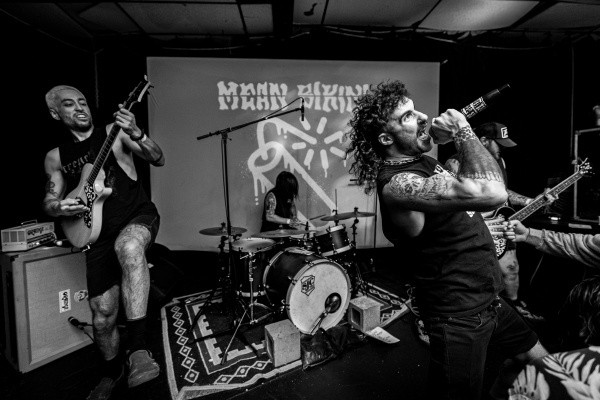
Mean Bikini have had a whirlwind of a year so far. They followed up their two great EPs (2023’s self-titled and Calculated Risks) with their debut full-length album This Ain’t Gonna End Well… in April (which we spoke to lead vocalist Milli Lyman about earlier this year) and hit the road for a massive 26-date cross-Canada tour. The band brought their dynamic punk rock to towns across British Columbia, Alberta, Saskatchewan, Ontario, New Brunswick, Nova Scotia, Prince Edward Island, Quebec, and Manitoba, generating a strong sense of community and catharsis at each show. Mean Bikini will be playing their final shows of 2025 across BC in December with Dead Bob and Danger Box.
Punknews editor Em Moore caught up with lead vocalist Milli Lyman, guitarist Josh Marcellin, bassist Laurie Storrie, and drummer Ashley Gelaude to talk about their recent tour, including what goes into putting a DIY tour together, their pre-show rituals, some of their favourite moments from this tour, and so much more. Read the interview below!
You recently wrapped up a cross-Canada tour. How did you decide which venues to book, which cities to play, and which bands to play with?
Milli: We have developed a lot of amazing connections over the past four years with bands and promoters across the country, so the first step is often figuring out how we can build on those connections. Another aspect we often consider is connecting with bands that share a similar ethos to us. When it comes to venues, we try to prioritize all ages and queer friendly/run spaces.
What goes into putting a cross-country DIY tour together? Do you have backup plans in place in case a show falls through?
Laurie: Heck, I feel like I could write a novel about this. We usually pick a destination, in this case Halifax, and try to balance how long it will reasonably take with how long we can be on the road without absolutely destroying our everyday lives. After that, we try to lay it out in a way where we see big towns on the weekends with minimal backtracking and dead space. We kinda work backwards from there.
When it comes to actual booking, it's a mixed bag. We’re lucky to have built solid connections in a bunch of towns over the past few years. Sometimes it's as easy as calling up another band and promoter and asking if they can put a show together for us. This tour saw us breaking some new ground, which gets a lot more hectic. My first step is exploring social media. So many towns have Facebook groups or Instagram pages for punk shows in their area, and while it’s easy enough to just hop on and ask if someone can help, I get really excited about doing a deep dive.
It’s one thing to get a show, but something totally different to get THE show. I’ll typically look at all the show posters on a page, then go listen to all the bands from that town in hopes of finding one that either sonically or politically matches Mean Bikini. Connecting with the audience has always been the biggest motivating factor for us, and putting together a lineup that meshes well feels like the best way to make that happen. In all fairness, there are a ton of times the first (five) bands we reach out to might not be available, but it’s exciting to ask them who their favourite local bands are and just keep following the trail until something works out. It’s also a great way to hear about dozens of incredible bands that you might otherwise miss out on.
I wouldn’t say we have concrete backup plans, but punk is such a beautiful network and it’s been pleasantly surprising to see how quick the community can pull something together when a show falls through on short notice.
How do you prepare to go out on the road?
Josh: Spend as much quality time with your partner and your cat as possible, because that’s what you’re gonna miss the most when you’re a thousand hours from home. Logistically, planning for sleeping on floors for a month helps too: get a good mat, sleeping bag, and pillow so you’re cozy even though you’re four people sardined in a stranger’s living room. Pack more underwear than you think you’ll need.
What did you learn about yourselves as people and as a band on this tour?
Ashley: On this particular tour, I think we had a massive opportunity to practice our ability to problem solve and execute as a unit in the wake of multiple vehicular breakdowns, extended time away from home/wages that we weren't anticipating, and many hours in the cold on the side of the road waiting for tow trucks. I think we’ve always had a knack for working together and getting along better than most groups, but we really got the chance to learn the scope of our group effort abilities this time around. In turn, we learned a lot about ourselves individually, as well as a unit.
Additionally, one month on the road together breeds space to see so many ends of each other's personalities, strengths, weaknesses, and moods. Despite us being a highly unproblematic bundle internally, any chance to learn how to better work with one another lends itself to the longevity and management of stuffing four completely different personalities into a small truck for eleven hours a day, five days back to back. Not for the faint of heart. But we have been blessed with the space to understand each other better, create space we might be able to personally rationalize for one another, and adore one another through the curveballs touring has a knack for fast-pitching at you in the blink of an eye.
What helps you look after yourself and your mental and physical health while on tour?
Milli: It looks different for each of us. Speaking for myself, I try to make sure I eat at least one relatively healthy meal a day, in between subsisting off copious amounts of fast food. This tour I started off sick, so right from the get-go I stocked up on supplements and took them every single day, something I’d never done on the road before and now will continue to do.
In terms of mental health, making sure I take space when I need it is crucial, even if it means going for a five-minute walk when we get to whatever town we’re playing. One of the best things I've discovered is hitting a sauna or steam room at some point. Taking that little bit of time to give your body some love and detox a bit does wonders for physical and mental energy!
What are your pre-show rituals?
Laurie: I like to walk a block from the venue and look back at it around the time doors open, taking a moment to just soak in the gravity of it all and remember how privileged I am to be able to do this. Looking at the surrounding buildings and how their architecture differs from home, trying to pick out unfamiliar smells in the air, watching new faces and old friends outside having a smoke and sharing a laugh. Then I put on the shortest shorts I can find and get ready to sweat my ass off.
Josh: For the longest time, I’d reliably need to poop five minutes before we’d go on stage. The antici-poop. Luckily, that’s less common now—it was always a panicky BM. Now, we usually just hug and say nice things to each other before we start playing.
Ashley: Make sure I have water on hand, relieve my bladder pre-set regardless of if it seems necessary, have gum ready to go for after the set 'cause gum always helps with anxiety, and connect with my bandmates/verbalize that we are just here to love each other and have fun on stage. It’s just us after all. It’s our world, our thing, our passion, and our energy that we share with the crowd. Immediately before grabbing my sticks, we always do a group hug and express our love for one another. Kisses on the head, squeezes, and gratitude. If there is one thing we can eternally agree on, it’s that we absolutely adore playing live together.
Milli: The preshow hug to me is most important. Some other things are making sure I'm in good sorts with the sound person and have at least one shot of tequila in me.
How do you ensure you’re creating a safe and inclusive space at your shows?
Milli: This one’s interesting. We are blessed with a community we know very well at home, but going into new spaces in new places you never really know how the spot or community functions in terms of inclusivity or being a safe space. All we can do is our best to carry our ethos with us and stay vigilant to ensure we can respond if things get weird or bad.
I suppose one specific instance in which we had to do a small amount of work on this was our Toronto show. There was a great crowd there, but as soon as our set started two very enthusiastic dudes took up the entire pit, smashing into each other. We let them have their fun for a bit, but when it became clear that other folks in the crowd weren't able to partake due to how hard these two people were going, we asked them to stop and take a step back so other folks could enjoy themselves as well. These shows are for everyone and we want to make sure everyone has room to express themselves and let out their energy.
What was your favourite show you played on this tour?
Laurie: There were so many exceptional shows for so many different reasons. I think for me it was Edmonton. Before this summer we had only played there once two years ago, and it didn’t seem like we had made a big impact. This year, we decided to put some more effort in and come back a few times. We had a decent show there in July, then came back for Purple City Music Fest in September where it felt like we hit a home run. This tour saw us come back on a Monday night and we showed up to a totally packed house. Aside from being just a fantastic show, it was a nice reminder that when you put the effort into an audience, they will put an effort into you.
Josh: Montreal at Thrash Can, the venue formerly known as Traxide. Realistically, this wasn’t my favourite, but it was the most memorable. This room is a cross between Shredder’s sick lair in the first Ninja Turtles movie and what I imagine a ‘90s East German punk squat looked like. Everyone was chain-smoking indoors.
The night we played was a birthday party for the venue manager, Spider Mike, and everyone celebrated by dressing up like clowns and whipping birthday cake everywhere. It was surreal. There’s like a Thunderdome chainlink balcony over the stage and all these French clowns are just dangling and climbing by the ceiling mid-set.
Ashley: There are an overwhelming amount of favourites off this tour, but if I had to pick one? Kitchener-Waterloo. Packed room, everyone was there to let go, the crowd was unbelievably involved and responsive. Additionally, Houndstooth in Toronto. Playing with our besties in Quit It! is always an everlasting gobstopper of admiration and appreciation for each other. Lots of support from loved ones and friends and better opportunities to connect with people who give us the time of day and show up for us.
Milli: All of them had their own unique charm, but playing the Thrash Can was like something out of a movie, so that was a big highlight for me for sure.
What is the most challenging part of being on tour? What is the most rewarding?
Ashley: Challenging? I would argue the most challenging part is being away from our beds, partners, cats, and chosen coffee brewed exactly the way we know. Additionally, the amount of go go go go. Four hours of sleep, straight into twelve hours of driving, straight into load-in, straight into soundcheck, straight into socializing and being ON, straight into the physical element of playing and not knowing if there is a shower at the end of it all. It’s easy to take creature comforts for granted, but being away from home, we all deeply miss the routines and seemingly simple things.
Most rewarding? Connecting with the crowd and hopefully making an impact. Be it creating space for people to celebrate, go mindless, dance hectically, grieve, or release their anger. It's a wildly cathartic experience for us and the crowd. Our music often covers heavy topics: addiction, suicide, government failure, working class unification, racism, homophobia, and transphobia, among many others. Connecting with people who struggle just like us in relatable ways is a power unlike any other. Additionally, the community and love of fellow musicians, promoters, and creatives who all show up just support/celebrate each other's success.
What would you like to see done to make touring more sustainable for bands?
Josh: It’s incredibly adventurous touring across Canada as a DIY punk band. The distances are extreme: we covered around 18,000 kms in a month. Cities in this country are far apart. You’re in the vehicle twelve-plus hours for days on end, spending absurd amounts on gas. Vehicles break down from the mileage. Touring can mean financial oblivion—food, hotels if you’re lucky, repairs—with no guarantee that you’ll make any money at a show you travelled all day to make.
But music, especially live music, is essential. It brings so much joy and community. It creates lasting bonds that can survive vast distances and time. And there are many measurable financial benefits. But the monetary risks are borne solely by the touring band. Sustainable and predictable grant funding to support live music would be incredible. There’d be so much benefit to having performers confidently travelling this country, sharing their music and their culture. We’d all be stronger for it.
What’s something people might not realize about going on tour as a DIY band?
Laurie: How hard it is to find your footing between the highs and the lows. Getting four or five hours of sleep on a floor only to get up and spend twelve hours in a vehicle takes a huge emotional toll on someone. Mix in constantly changing time zones and an inconsistent diet of predominantly fast food and reality starts to crumble a bit. There were no shortage of times on this tour I’d have to ask myself, “Am I grumpy or just hungry? Sad, or just exhausted? Do I have any emotions at all?”
The next thing you know, you’re at a venue, making new friends, watching incredible bands, and pouring out a day's worth of energy into thirty minutes of your favourite thing in the world. How do you quantify having your best and worst day within the same 24 hours?
What touring advice would you give to bands just starting out?
Laurie: Two things. First, shoot for the moon. Trying to make it as a band-whatever that might mean to you-is kinda a ridiculous endeavor in general; there are so many sacrifices to make in a world that constantly feels it’s working against you. That sounds negative, but I just say it to highlight the passion and resilience of musicians. If you’re in a band I can only assume it’s because you love what you are doing, so take that love and set your goals as high as you can. Take the risks, ask to open for your favourite bands, work with your favourite photographers, get a great graphic designer to do your merch. When people fall in love with your music, they are investing part of their heart into you, show them that their stock is in good hands.
Secondly, be good to everyone you meet. The kids at the door, the bartenders, the sound person, the other bands, their merch person, every single one of these people can be your biggest resource (or your worst nightmare). The music will take you a long way, but if you make a good impression on everyone as a human being you are opening countless new doors to success.
What did it feel like to connect with punk scenes across the country?
Milli: This was probably my biggest takeaway from the tour. It feels surreal and so heart-filling to be able to travel the entire length of the country and back and each night make new or continue to build on connections with people who share similar values, love doing the same shit, and are there because they believe in something. Living in a small rural community at times can feel isolating, but taking pause to reflect on the massive and wide-spanning family we have through music dissolves that feeling of isolation pretty quickly. Everywhere we went we were seeing youth coming out to shows, queer people being empowered and more and more good, kind people living in the margins of society taking up the space they deserve. I feel very confident in saying the punk scene in Canada is absolutely thriving.
What surprised you the most on this tour?
Laurie: Seeing so much growth since we last crossed Canada two years ago. The first time we did this there were a good handful of shows that had ten or fifteen people in the audience. This time around, there was rarely less than fifty. It’s such a good reminder that people are paying attention and it’s always worth it to keep putting in the work.
Ashley: I will second Laurie on being grateful for the tangible and obvious growth we’ve encountered on the road. Seeing faces we met a year or two ago showing up again, the sheer volume of people willing to come out on a work night, reaffirming connections made in the past, and seeing our return have any kind of impact at all.
Is there anything I didn’t ask you that you’d like to add?
Milli: I’d like to take a sec just to say to anyone reading this who's interested in touring that it is an absolutely attainable goal. When I first started playing music and for a long time after, even a few date long tour seemed like this insurmountable goal. It's hard to know where to start, but once you start reaching out to bands and venues and promoters and building those connections, it gets a hell of a lot easier and you realize how far you can actually get. If anyone needs assistance in figuring out how to book a tour for themselves, please feel free to reach out!
| Date | Venue | City | Details |
|---|---|---|---|
| Dec 05 | The Globe | Nanaimo, BC | w/Dead Bob, Danger Box |
| Dec 06 | Encore | Victoria, BC | w/Dead Bob, Danger Box |
| Dec 07 | Comox Valley Curling Center | Courtenay, BC | w/Dead Bob, Danger Box |